1. The Common Procurement Blind Spot in C14 Lithium Disilicate Sourcing
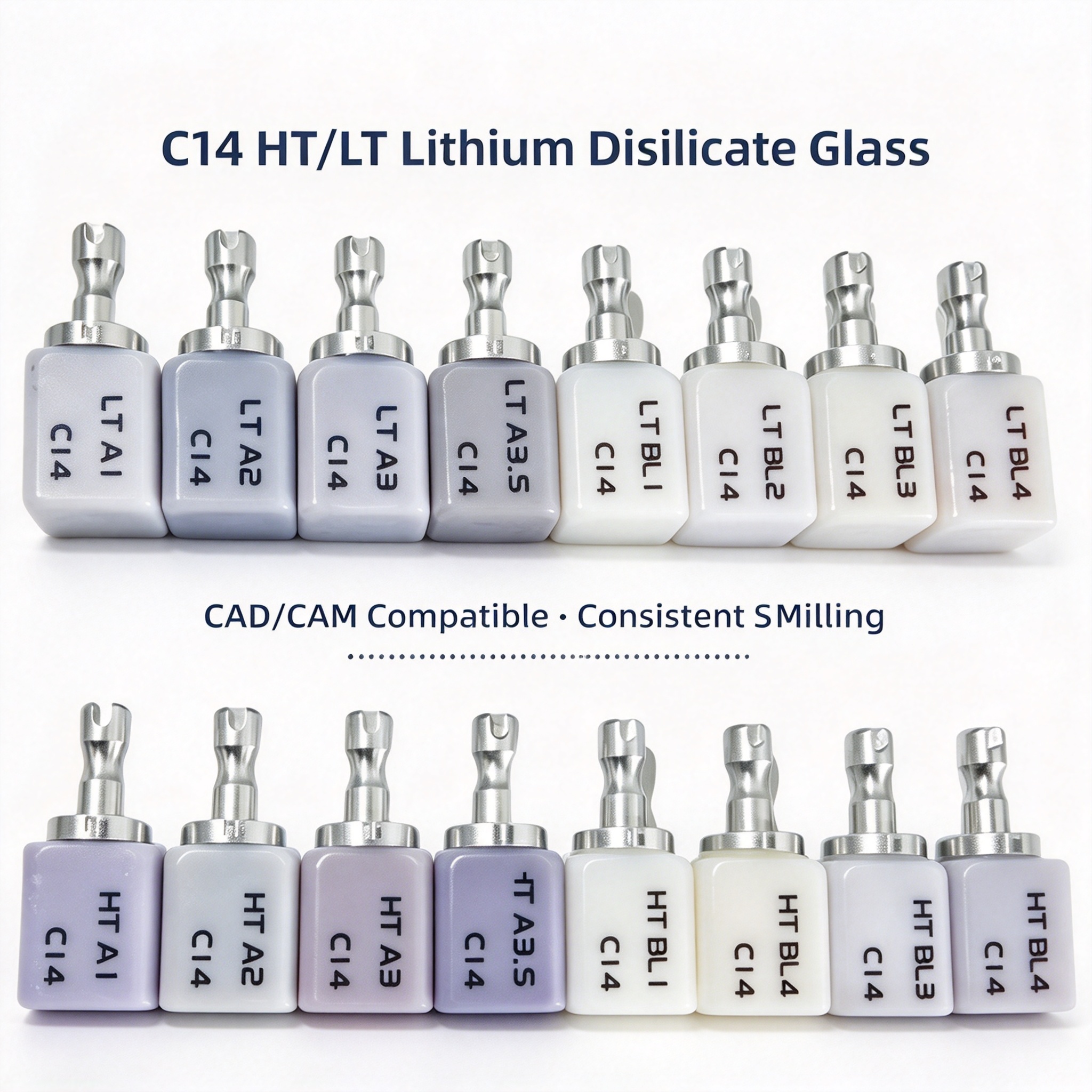
Dental labs, group clinics, and equipment distributors often follow a narrow checklist when sourcing C14 lithium disilicate CAD/CAM blocks: confirm the blank is labeled compatible with CEREC systems, match the C14 standard holder dimension, and place bulk orders based on unit price. This approach overlooks a critical layer of material and process fit: the inherent compositional differences between high-translucency (HT) and low-translucency (LT) shade grades, and how those differences interact with the specific parameters of each clinic or lab’s existing CEREC hardware. Many teams report unexpected edge chipping, marginal fit deviations, or inconsistent optical results after switching blank brands, and incorrectly attribute these issues to poor brand quality or a fundamental mismatch between HT/LT grades and CEREC milling. In reality, these outcomes often stem from a failure to map material properties, machine parameters, and clinical use cases before purchase. C14 is a universal blank dimension compatible with most mainstream chairside milling systems, not a proprietary brand-specific specification, which means a wide range of compliant blanks can physically fit a CEREC holder — but physical fit does not equal process performance fit.
2. Inherent Material Differences Between HT and LT Lithium Disilicate Grades
To evaluate milling consistency, it is first necessary to separate inherent material properties from manufacturing defects. Lithium disilicate glass ceramics derive their core clinical value from a microstructure of needle-shaped Li₂Si₂O₅ crystals embedded in a glass matrix, delivering the combination of high strength and natural translucency that makes them a dominant choice for chairside all-ceramic restorations. HT and LT grades are formulated to serve different clinical aesthetic needs, and their compositional differences directly shape milling behavior. HT grades have a lower crystalline phase fraction and higher glass phase content, which produces higher post-sintering translucency that closely mimics the optical properties of natural enamel. Because glass is more brittle than the interlocking crystalline phase, HT blanks are inherently more prone to micro-chipping along sharp restoration margins during milling. LT grades have a higher crystalline phase fraction and lower glass phase content, which delivers higher post-sintering strength, lower translucency, and better masking power for discolored abutments or metal cores. The higher crystalline content gives LT blanks greater inherent toughness during machining, leading to more consistent chipping resistance across standard milling operations. These differences are built into the material chemistry, not a sign of inconsistent quality from any specific brand. A blank that mills perfectly on one system may show minor edge fragility on another, purely because of the material’s inherent composition.
3. The Real Drivers of Milling Performance Variability Across CEREC Generations
There is no universal rule that HT grades will always produce worse results, or that LT grades will always deliver perfect marginal fit, across every CEREC setup. Milling performance is shaped by three interconnected process variables, not the HT/LT label alone. First, CEREC systems across different product generations use different default core parameters, including spindle speed, feed rate, and cooling spray volume. A parameter set calibrated for one blank composition may be too aggressive for a more brittle HT grade, or leave unnecessary tool wear if applied to a tougher LT grade. Second, cutting tool wear state is a major contributor to edge chipping and marginal inaccuracy. Even the most compositionally matched blank will produce flawed restorations if milling burs are used past their recommended wear threshold. Third, the sintering program used after milling must match the blank’s manufacturer-specified temperature and duration profile. A mismatch between the loaded sintering recipe and the blank’s composition can create dimensional shrinkage deviations that ruin marginal fit, even if the green-state milled restoration was dimensionally perfect. Industry data confirms that most reported chipping and fit issues with lithium disilicate blanks trace back to these three controllable process gaps, rather than an inherent incompatibility between HT/LT grades and CEREC hardware. No public, standardized cross-brand dataset exists to rank HT or LT blanks by universal chipping rate or marginal fit value, because results are so heavily dependent on each lab or clinic’s unique process setup.
4. A Scenario-Based Selection Framework for Different Purchasing Models
There is no universally superior HT or LT grade. The right choice depends on three aligned factors: clinical indication, existing equipment capability, and organizational procurement model. For anterior aesthetic restorations placed on naturally colored abutments, HT grades are the logical choice, as their higher translucency delivers the most natural optical match to adjacent enamel. Teams selecting HT blanks should confirm the supplier provides published recommended milling parameters and matching sintering program files for their specific CEREC generation, to reduce the risk of edge micro-chipping. For posterior occlusal restorations, or cases involving discolored abutments or existing metal post cores, LT grades are the more practical choice, balancing higher structural strength with sufficient masking power. The selection logic shifts based on the scale of the purchasing organization. Large commercial dental labs with dedicated process engineering teams can run controlled in-house trials of multiple compliant C14 blank brands, adjusting spindle speed, feed rate, and sintering programs to balance material cost and process stability, since they have the bandwidth to iterate on parameter matches. Small private clinics with limited in-house technical support are better served by selecting C14 blanks from suppliers that provide clear, pre-tested parameter guidance and responsive technical support for CEREC workflows, to minimize trial-and-error costs and avoid wasted restorations. Distributors serving both lab and clinic clients should prioritize suppliers that publish full parameter documentation for HT and LT grades, rather than only marketing generic CEREC compatibility claims.
5. Core Takeaway for Balanced Sourcing
The biggest mistake in C14 lithium disilicate procurement is reducing the decision to a simple check for CEREC compatibility and C14 dimension fit. HT and LT grades have inherent, chemistry-driven differences in brittleness and toughness that shape milling behavior, but these differences do not determine final restoration quality on their own. Consistent milling results come from matching blank composition, machine parameters, tool maintenance schedules, and sintering programs to the specific clinical indication. For every stakeholder, the optimal choice is not the highest-translucency or lowest-cost blank on the market, but the blank grade that aligns with their equipment setup, clinical case mix, and internal technical support capacity.